Don't Abuse the Greek
Seven guardrails, the famous word-study myths debunked kindly, and the exact phrases that let you teach Greek insights without ever overclaiming.
The Big Rule
Greek clarifies Scripture. It never gives you permission to ignore the sentence the word sits in. The best original-language insight makes the passage feel more trustworthy and the Savior more glorious. Not the teacher more impressive.
This pack exists because you're going to teach: a class, a small group, your kids at the dinner table, a friend over coffee. And the moment you say “in the Greek...”, people lean in and believe you. They'll start bringing you their hard questions, because you're the one who studies. That is a holy kind of power, and it deserves guardrails. Here are seven, each with a famous wreck to learn from.
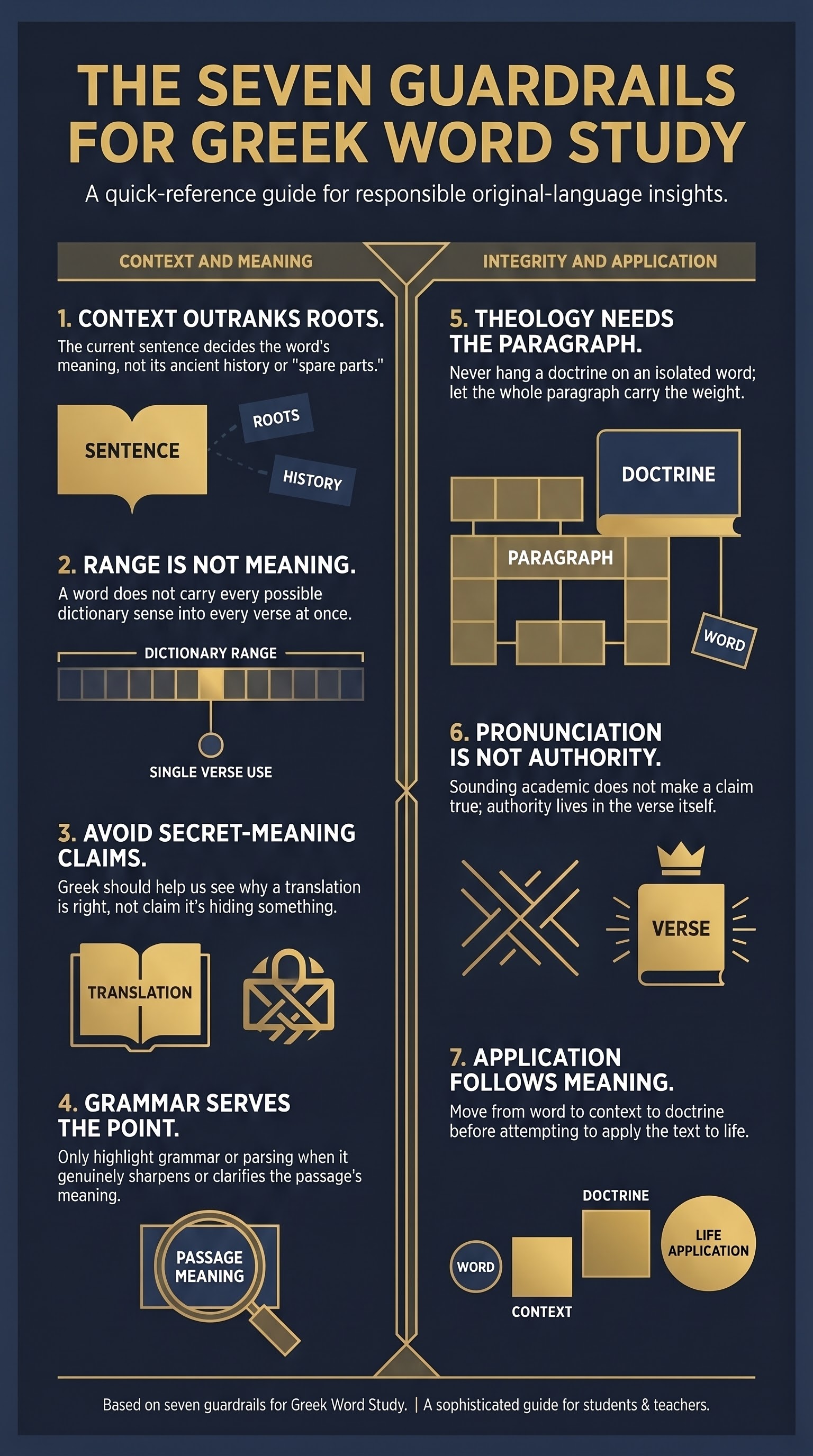
The Seven Guardrails
1. Context outranks roots. A word's history is interesting; the sentence decides the meaning. Famous wreck: “ekklesia comes from ‘call out,’ so the church really means the called-out ones.” In ordinary Greek it just meant an assembly. Acts 19 uses it for a riot. Say instead: “In this sentence the word means assembly. The wonder is that Jesus calls it his, and promises to build it.”
2. Range is not meaning. A word does not carry every possible sense in every verse. Famous wreck: pouring “reason, logic, speech, account, ratio” all into logos in John 1:1 at once, until the verse means everything and therefore nothing. Say instead: “Of all the things this word can mean, here is the sense this passage requires, and here is how the context shows it.”
3. Avoid secret-meaning claims. If a claim makes your English Bible sound like it has been hiding the gospel from you, the claim is too strong. Famous wreck: “Your translation says word, but the Greek REALLY means...” followed by something no translation committee on earth chose. Say instead: “Your translation is right. The Greek helps us see why it's right, and adds a detail worth savoring.”
4. Grammar serves the point. Don't parade parsing that changes nothing. Famous wreck: announcing “this verb is an AORIST!” as if the aorist itself meant “once-for-all.” In the indicative it is usually just the ordinary, undramatic past tense. Say instead: mention grammar only when it genuinely sharpens the meaning, like the perfect tense in “it is finished”: completed action with standing results.
5. Theology needs the paragraph. Never hang a doctrine on one isolated word. Famous wreck: building the whole doctrine of justification on the single participle in Romans 3:24 instead of the paragraph (3:21–26) that actually carries it. Say instead: “Watch how the whole paragraph builds, and notice this one word doing its part inside it.”
6. Pronunciation is not authority. Saying a Greek word smoothly does not make a claim true. Famous wreck: a confident “the word here is ah-GAH-pay” used as if the accent settled the interpretation. Say instead: nothing. Pronounce it or don't; then show your claim from the verse, which is where authority actually lives.
7. Application must follow meaning. Move word → context → doctrine → worship, in that order. Famous wreck: jumping straight from dunamis to “God's dynamite power will blow up every obstacle in your life!” Application launched before meaning landed. Say instead: “Here is what the word means in this verse; here is what that teaches us about God; now here is how we live it.”
Famous Word-Study Myths You Have Probably Heard
None of these myths comes from bad people. Most come from good preachers repeating something that preached well. Learn them kindly. You've probably repeated one or two yourself. We all have.
“Dunamis means dynamite”
Romans 1:16: the gospel is the dunamis of God. Alfred Nobel coined “dynamite” from the Greek word in the 1860s; Paul was not thinking of explosives eighteen centuries early. That's an anachronism: reading a modern word back into an ancient one. The verse's real claim is better anyway: the gospel itself, preached plainly, is God's own power to save.
“Agape is divine love, phileo is mere friendship”
The two words do often differ in flavor, but not as a fixed theological system. In John 21 Jesus and Peter alternate them in a way that resists the neat scheme, and the Greek Old Testament even uses the agape family for Amnon's wicked desire in 2 Samuel 13. The beauty of John 21 is the threefold restoration of a three-time denier. That much is sure, whatever you make of the verb swap.
“Rhema is God's NOW word; logos is just the written word”
The New Testament uses these two words with broad overlap. Both can mean a word, a saying, a message. Building a two-tier theology of revelation on the pair reads a system into the vocabulary that the texts don't sustain. The sure claim: God speaks through his written Word, and the Spirit makes it living and active (Hebrews 4:12, which, by the way, uses logos).
“Ekklesia means the called-out ones”
The classic root fallacy: ek + kaleo dissected into a doctrine. In everyday usage the word simply meant an assembly (Acts 19:32 uses it for a riot). God truly does call his people. Get that from Romans 8:30 and 1 Peter 2:9, where it is actually taught, and let Matthew 16:18 say its own stunning thing: Jesus builds his church.
“Repentance just means a change of mind”
Metanoia's parts do suggest a changed mind, but New Testament usage shows whole-life turning. John the Baptist demands “fruits in keeping with repentance” (Luke 3:8), and Paul says he preached that people “should repent and turn to God, performing deeds in keeping with their repentance” (Acts 26:20). Reducing it to a private mental adjustment shrinks a word the Bible uses for a changed direction of life.
“Monogenes must mean only begotten” (or must not)
Handle this one gently. Older translations rendered John 3:16's monogenes “only begotten”; many modern scholars connect it to genos (kind) and render “one and only” or “unique.” Faithful scholars and faithful traditions sit on both sides, and historic Christianity confesses the Son's eternal relationship to the Father either way. If you teach the verse, the sure claim is John's: the Father gave his unique, beloved Son. Say plainly that the rendering is discussed. Your honesty will build more trust than false certainty.
The 90-Second Claim Audit
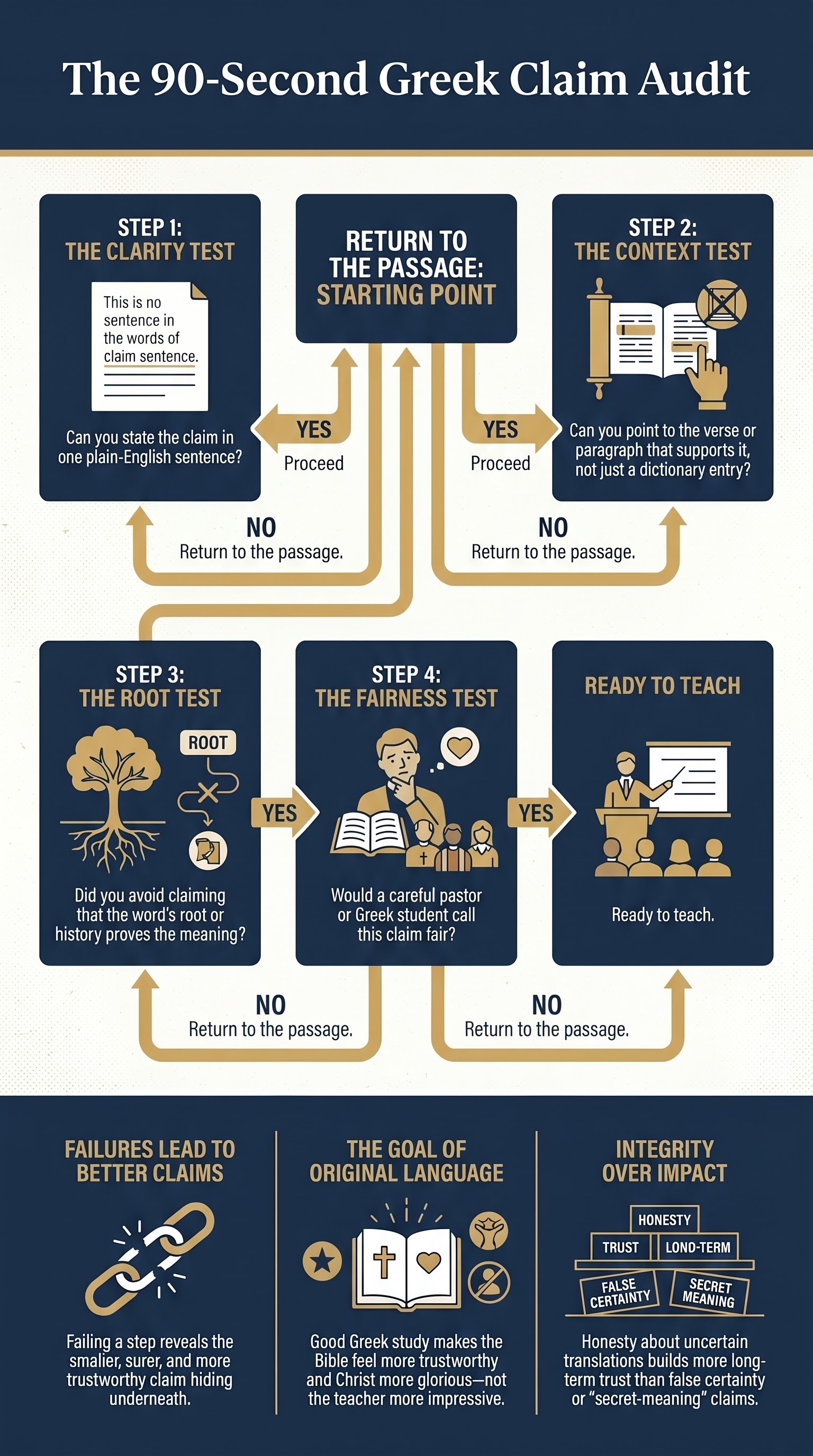
Before you say “in the Greek...” out loud, in a lesson, a post, or a conversation, run the claim through these five questions. It takes ninety seconds and it has saved us more than once.
- Can I state the claim in one plain-English sentence?
- Can I point to the verse or paragraph that supports it, not just a lexicon entry?
- Have I avoided saying the root or the etymology proves the meaning?
- Have I named what I am not claiming?
- Would a careful pastor or a first-year Greek student call this fair?
If a claim fails the audit, you haven't lost anything. You've usually just found the smaller, surer, better claim hiding underneath it.
Safer Teaching Phrases
Small changes in wording keep you honest and keep your hearers trusting their own Bibles. Steal these freely:
Instead of: The Greek literally means...
Say: In this passage, the word carries the sense of...
Instead of: English misses this...
Say: The Greek helps us notice...
Instead of: The root proves...
Say: The context points us toward...
Instead of: This changes everything...
Say: This deepens what the passage already says...
Debate Night: Hear Both Sides
Some arguments are better heard than read. These two episodes stage the real fights, give both sides their strongest case, and let the text settle what it can settle.
Word studies: hidden treasure or trap? The enthusiast versus the careful scholar. Where the line really sits, and how to keep the treasure without the trap.
Agape versus phileo: real distinction or sermon myth? The beloved John 21 preaching point gets its day in court. What John 21 actually offers turns out to be more beautiful than the myth.
Print These: The Poster and the Flowchart
The Seven Guardrails poster. All seven on one page, ready for your study wall or the back of your Bible.
The 90-second claim audit, as a flowchart. The four questions in order. Yes moves you forward. No sends you back to the passage.
When You Hear It From the Pulpit
Sooner or later, maybe this Sunday, you'll hear one of these myths preached by someone you love and respect. Here's how to carry what you now know without becoming the Greek police.
First, weigh it. Did the shaky word study change the doctrine, or just decorate it? If the sermon said “dunamis means dynamite” on the way to “the gospel is God's power to save,” the destination was right even though the route was wrong. Let most of it go. Grace covers illustrations too.
If it matters, ask privately, with a question, not a verdict. “Pastor, I've been reading about that word. Have you run across the discussion on it?” honors the office and opens a conversation. A correction in the lobby, in front of others, closes one.
Remember your own file. You believed some of these myths a month ago, and you may be teaching next month's correction right now without knowing it. Hold others to the standard you'd want applied to you: truth, sought together, gently.
And never let a botched word study make you cynical about preaching. The same pulpit that mangles a Greek root usually proclaims a crucified and risen Christ. Keep first things first.