
Why John 1:1 deserves a month of your attention
The overture: what's at stake in one verse, and where this course is taking you.
A verse-by-verse deep study of John 1:1–18 with an eight-chapter audio edition (30+ minutes), the Genesis 1 echo, the Old Testament trail behind “the Word,” the grammar of “the Word was God,” the Nicaea story, a complete teaching outline, and a week of devotions.
You're about to spend more time in eighteen verses than most people spend in a book of the Bible. Good. John 1:1–18 is where the church learned to say who Jesus is: eternal, personal, divine, and near. The early church fathers lived in this prologue. Entire creeds stand on its sentences. Men went to exile and worse over its grammar. One month from now, you'll know why, and you'll be able to explain it to someone you love without a single seminary word.
That's the real promise of this masterclass. Not that you'll sound impressive. That you'll be ready. Ready when your kid asks why we say Jesus is God when the Bible calls him God's Son. Ready when a friend texts you at 9 p.m. because someone at their door said John 1:1 really says “a god.” Ready to open the text, walk through it slowly, and answer with quiet confidence instead of a nervous change of subject. God gets the glory. You get to be useful. Both of those are good.
Here's the route. First, how to take the course, and the full audio edition for your drives. Then the background John's first readers carried: Genesis 1, the Old Testament's “word of the LORD,” and what logos meant on a Greek street corner. Then five movements through the prologue itself, each with the text, what to notice in the Greek, what it means, and a note for worship, because exegesis that doesn't kneel hasn't finished. Then the hard question you'll actually be asked at your door, the story of how the church fought for this verse at Nicaea, and the stunning bookends John builds between “in the beginning” and “it is finished.” We close with everything you need to teach it, and a week of devotions to pray it all back.
What you get inside this masterclass:
Read it with your Bible open. This module is the tour guide; the prologue is the cathedral.
This course has two tracks that teach the same material: the written study on this page and the eight-chapter audio edition just below. They're built to work together. The text goes deeper and shows you the Greek on the page. The audio carries the same teaching in a warmer register, for the car, the kitchen, or the walk. Use both and the material will stick in a way neither could manage alone.
Here's the rhythm we recommend:
Before you dive into chapters, press play. This overview walks the full arc of the masterclass in about nine minutes: the Genesis echo, the five movements, the grammar of “was God,” Nicaea, and the Word made flesh. Watch it once now so every written section lands inside a story you already know. Then come back to it the night before you teach.
The complete masterclass, taught in eight audio chapters, more than thirty minutes of teaching you can take anywhere. Each chapter pairs with a written section below. Press play on chapter one the next time you're in the car, and let John 1:1 ride shotgun.
The overture: what's at stake in one verse, and where this course is taking you.
The deliberate echo: same opening words, same speaking God, same light against darkness.
The Old Testament trail: Psalm 33, Isaiah 55, Proverbs 8, and the background John's readers carried.
From everyday Greek to Heraclitus and the Stoics, and how John out-claims them all.
A guided walk through the whole prologue: was, with, was God, became flesh, and what we become.
What the missing article does and doesn't mean, and how to answer “a god” with warmth.
The tent, the glory, and the God who moved into the neighborhood.
How to give this away: the outline, the guardrails, and the heart behind the lesson.
Prefer one unhurried conversation to eight chapters? This long-form episode walks the entire masterclass in a single sitting: two voices, open Bibles, no hype. It pairs well with a long drive.
You will meet this objection eventually, so we staged it. One voice makes the strongest honest case for the “a god” rendering, the way a thoughtful visitor at your door would. The other answers from the text: the grammar, John 1:3, the Shema, Thomas’s confession, Nicaea. Nobody shouts. The text wins.
If you want to understand John 1, don't start in Greece. Start in Genesis. John did. His first two words are not just similar to the opening of the Bible; in the Greek Old Testament his readers knew, they are identical. Genesis 1:1 in the Septuagint begins ἐν ἀρχῇ, “in the beginning.” John 1:1 begins ἐν ἀρχῇ. A first-century reader couldn't miss it any more than you could miss a book that opened “It was the best of times.” John is holding up Genesis and saying: read this again, and this time, see him.
Creation by speech. Walk back through Genesis 1 and watch how God creates. He doesn't shape the light with his hands. He speaks. “And God said, let there be light.” “And God said” drives the whole chapter, beat after beat, like a drum. In Genesis, the word of God is how everything came to be. So when John says “all things were made through him” about the logos, he isn't decorating. He's answering a question Genesis raises: when God said, what happened? John's answer: the Word went out, and the Word was not a sound wave. The Word was a Someone. The speech of God turns out to be the Son of God. John doesn't footnote that claim; the rest of his Gospel will prove it, with a Word who speaks to storms and tombs and they obey.
Light against darkness. Genesis 1:3–4: the first thing God speaks into the dark is light, and God separates the light from the darkness. Now hear John 1:4–5: “In him was life, and the life was the light of men. The light shines in the darkness, and the darkness has not overcome it.” Same players, same stage. And John's verb at the end, κατέλαβεν, can mean “overcome” or “grasp, comprehend,” and translators genuinely discuss which John meant. He may well have wanted both: the darkness neither understood the light nor put it out. Either way, John has restaged Genesis with the stakes raised, because this time the light has a face.
A new week. Here's an observation many careful readers of John have noticed, and we'll hold it as an observation, not a doctrine. After the prologue, John starts counting days: “the next day” (1:29), “the next day” (1:35), “the next day” (1:43), and then “on the third day” there's a wedding in Cana (2:1). Add it up and John's opening narrative walks you through about a week, ending with the first sign, water into wine, where Jesus “manifested his glory.” Genesis opens with a week of creation; John opens with what looks like a week of new creation, crowned with glory at a wedding. Scholars discuss exactly how to count the days and how much weight the pattern should bear, so don't preach it as a hidden code. But as a frame for the Gospel, it's hard to unsee: John believes that in Jesus, God is starting the world again.
Order out of formlessness. Genesis 1:2 describes the earth before God speaks: tohu wabohu in Hebrew, “formless and empty,” dark water without shape or fullness. Then the word of God goes to work, and step by step the formless gets formed and the empty gets filled. Days one through three give the world structure; days four through six fill it with light-bearers, swimmers, flyers, walkers. That is what the word of God does: it takes chaos and makes a home. John wants you to carry that picture into his Gospel. The same Word who ordered the deep now wades into the disorder of the world, and of your life, with the same intent. He is not coming to inspect the chaos. He is coming to make it a dwelling.
See it side by side. Here's the whole echo on one table. Read the left column, then the right, and feel how deliberately John composed his opening:
| Genesis | John |
|---|---|
| “In the beginning, God created the heavens and the earth” (1:1) | “In the beginning was the Word... all things were made through him” (1:1, 3) |
| “And God said, ‘Let there be light’” (1:3): creation happens by God speaking | The agent of creation is called “the Word”: God's speech turns out to be a Person |
| Light shines, and God separates light from darkness (1:3–4) | “The light shines in the darkness, and the darkness has not overcome it” (1:4–5) |
| A week of creation days, ending in completion and rest (1:1–2:3) | A counted sequence of days, ending in glory revealed at Cana (1:29–2:11) |
| “The heavens and the earth were finished” (2:1) | “It is finished” (19:30), then rest in the tomb on the Sabbath |
| God breathes the breath of life into the man (2:7) | The risen Jesus breathes on his disciples: “Receive the Holy Spirit” (20:22) |
John didn't invent “the Word.” He inherited it. His own Scriptures had been talking about the word of the LORD for a thousand years, and that trail is the deep background of John 1:1. Walk it with me.
Dabar: the word that does things. The Hebrew word is dabar. In the Old Testament, “the word of the LORD came to...” is almost a job description for a prophet. But notice the verb: the word came. It arrives. It acts. In Hebrew thinking, God's word is not information about God; it is God going forth in power. When the word of the LORD comes to Jeremiah, something happens to Jeremiah.
Psalm 33:6: the word that builds. “By the word of the LORD the heavens were made, and by the breath of his mouth all their host.” The psalmist looks up at the night sky and credits it to speech. Notice, too, the pairing: word and breath. Centuries later, Christians would read that line and hear more than the psalmist could have known: the Father, the Word, and the Breath. Make that a devotional delight, not a proof text. The sure claim is the psalm's own: the universe exists because God spoke.
Isaiah 55:10–11: the word that cannot fail. God compares his word to rain and snow: it goes out, waters the earth, and does not return empty, “but it shall accomplish that which I purpose.” God's word has a mission and a success rate of one hundred percent. Now read John 1:14 with that in your ears. The word that goes out from God's mouth and accomplishes his purpose finally went out in person. And when his mission was accomplished, he said so, out loud, from a cross. We'll get there.
Proverbs 8: wisdom at the building site. Proverbs personifies Wisdom as a woman calling in the streets, and in 8:22–31 she speaks of being with God before the depths, before the mountains, “like a master workman,” delighting in the world he made. Sound familiar? It should: someone with God at creation, agent of his making, his daily delight. The early church loved this passage, and one group abused it. The Greek translation of 8:22 can be read “the LORD created me at the beginning,” and Arius (you'll meet him properly two sections down) used that line to argue the Son was a creature. The careful answer is that Proverbs 8 is poetry personifying God's own wisdom, not a biography of the Son, and a poetic personification cannot overrule John's plain grammar: the Word was. Treat Proverbs 8 as background music for John 1, beautiful and suggestive, and let John carry the doctrine.
Two quieter threads. Two more pieces of background deserve a careful mention. First, the Angel of the LORD: in passages like Exodus 3 and Genesis 22, the angel speaks as God in the first person, and readers have long discussed what to make of that. Some Christians have seen pre-incarnate appearances of the Son; others read it differently. Hold it lightly. It's a discussion, not a doctrine. Second, the Memra: in the Aramaic paraphrases read in some synagogues (the targums), “the Word of the LORD” often stands in where the Hebrew text simply says “the LORD.” God creates, saves, and covenants by his Memra. The dating of those paraphrases is debated, so don't claim John quoted them. But they show that Jewish ears were already used to hearing “the Word of the LORD” act like God himself. When John said the Word made all things, his readers' Scriptures had been warming up that idea for centuries.
Now the other river. Logos was one of the most ordinary words in the Greek language, and one of the most exalted, and John chose it knowing both.
On the street. In everyday Greek, logos meant a word, a statement, a message, an account. A merchant kept a logos of what you owed him. A messenger carried a logos from one city to another. When the New Testament says people “spread the word,” that's logos doing its ordinary day job. Nothing mystical. Remember that, because it keeps us honest: John picked a word real people used at the market, not a secret term for insiders.
In the academy. But logos also had a five-hundred-year philosophical resume. Heraclitus, around 500 BC, used it for the rational principle that holds a changing world together. The Stoics built a whole way of life on it: the logos was divine reason threaded through the cosmos, and wisdom meant living in step with it. By John's day, a thoughtful Greek who heard “in the beginning was the logos” would nod along: yes, of course, the ordering principle behind all things. A Jewish philosopher in Alexandria named Philo had even been using logos to describe how a transcendent God interacts with the world. Scholars discuss how much, if any, of Philo John knew, so we won't build on that. The point stands without him: the word was in the air.
And here's what everyone missed. For every Greek thinker, the logos was an it. A principle. A force. You could contemplate it. You could align your life with it. You could not be loved by it, and it would never know your name. Then John writes his sentence, and by verse 14 the philosophical roof falls in: the logos became flesh and pitched his tent among us. No Stoic ever said the ordering principle of the universe got hungry. John says he did, and that he did it for you.
So when John chose logos, he wasn't borrowing a philosophy. He was out-claiming one. To the Greek mind: the principle you guessed at is a Person, and he was with God, and he was God. To his own people: the word that came to the prophets has now come in person. Both audiences heard their biggest idea picked up, and then dwarfed.
The text. Ἐν ἀρχῇ ἦν ὁ λόγος: “In the beginning was the Word.”
What to notice. John's first two words are the Greek Old Testament's first two words. Genesis 1:1 in the translation John's readers knew begins en archē, and John takes that opening line and writes a new sentence with it. Genesis: in the beginning, God created. John: in the beginning, the Word already was. He's deliberately writing a Genesis for the new creation, and we walked the full echo a few sections back: the speaking God, the light against the darkness, the week of days. Keep all of that in your ears here.
What it means. When the beginning began, the Word was already present. John does not say the Word was created first, or appeared early, or showed up in time for the important parts. He places the Word on the Creator's side of the line that divides God from everything God made. There are only two kinds of reality: God, and what God created. Verse one, word one, John tells you which side the Word is on. Whatever else the prologue says, it starts here: before time, the Word.
Slow down on one word: “already.” Most of us quietly picture Jesus entering the story at Bethlehem. John spends his first sentence demolishing that picture. Bethlehem is the middle of the story. The Word's own story has no first page. Every Christmas carol you've ever sung is about someone older than the world the manger sat in.
The text. The verb John chooses: ἦν, “was.”
What to notice. John runs two verbs through his prologue like two colors of thread. Of the Word: ἦν, “was.” Ongoing existence, no starting point in the frame. Of created things: ἐγένετο, “came into being” (1:3, “all things were made through him”). The Word was; everything else became. Watch the thread run: verse 1, the Word was, three times. Verse 3, all things became through him. Verse 6, John the Baptist became, a man sent from God. Even the greatest prophet of the age gets the creature's verb. The grammar quietly draws the deepest line in the universe, and it never wavers.
What it means. The Word has no birthday. There was never a “before” for him. Every created thing, from galaxies to angels to you, came into being through him; he himself simply was. This is why the church confesses the Son as eternally God, not as God's first and finest creature: John's verbs got there before the creeds did. When the bishops at Nicaea wrote “begotten, not made,” they were defending John's verb choice with their lives. We'll tell that story properly in a few sections.
A note of care. Don't claim the imperfect tense “proves” eternity all by itself; ἦν is an ordinary past-tense verb that shows up in ordinary sentences. The argument is the contrast John builds: he had ἐγένετο available, used it for everything created, and refused it for the Word until the Word chose flesh. That pattern is deliberate, and the pattern is the point.
The text. καὶ ὁ λόγος ἦν πρὸς τὸν θεόν: “and the Word was with God.”
What to notice. The preposition πρός here speaks of relationship: the Word existing in living orientation toward God. (You may have heard preachers say it means “face to face.” That presses the preposition a little harder than it strictly proves, so make the careful claim: the Word is with God, personally distinct, in relationship.) And notice that John repeats the line in verse 2, “he was in the beginning with God,” which is John's way of underlining. He will not let you read past the distinction, because everything he says next depends on it.
What it means. The Word is not the Father wearing a different mask, and not a force radiating from God. He is distinct enough to be with God. Before creation there was already fellowship: knowing and being known, loving and being loved, within God's own life. Jesus prays exactly this in John 17:24: “you loved me before the foundation of the world.” Before there were stars to see it or angels to sing about it, there was love. That is the oldest fact in existence.
Why this clause matters to your prayers. If God were a solitary monad, love would be something he started doing after he made someone to love. John says otherwise: love is what God eternally is, Father and Word in fellowship. Which means when you're invited into fellowship with God, you're not being recruited into a program. You're being welcomed into something that was already happening.
The text. καὶ θεὸς ἦν ὁ λόγος: “and the Word was God.”
What to notice. John puts θεός, “God,” first in the clause, the emphatic position: what the Word was, was God. And he writes it without the article, which (as we'll unpack in its own section soon) is the normal way Greek points to what something is rather than flattening two persons into one. Six words, and not one of them could be swapped without losing a truth. John has built a sentence that confesses full deity without erasing the distinction he just drew.
What it means. Everything God is, the Word is. Not a second, smaller god; John is a monotheist to his bones, raised on the Shema: “Hear, O Israel: the LORD our God, the LORD is one.” Not the Father himself; verse one just said the Word was with God. The Word is God, distinct from the Father, sharing the one divine life. The rest of the Gospel will cash this out: the Word gives life (1:4), creates all things (1:3), and receives Thomas's confession without correcting him: “my Lord and my God” (20:28).
Feel the weight. Try to feel how much it cost a first-century Jew to write this clause. John's people had bled rather than call Caesar a god. Monotheism wasn't a doctrine they held; it was the identity they died for. And this man, that people, writes: the Word was God. Either he had lost his mind, or he had seen something at a fishing net, a cross, and an empty tomb that left him no other sentence to write.
The text. Καὶ ὁ λόγος σὰρξ ἐγένετο καὶ ἐσκήνωσεν ἐν ἡμῖν: “And the Word became flesh and dwelt among us.”
What to notice. Remember John's two threads: the Word was (ἦν), creation became (ἐγένετο). In verse 14 John crosses the threads on purpose. The Word became, ἐγένετο, flesh. The verb he refused for thirteen verses, he now hands to the Word, because the Word chose it. The eternal One took on a beginning among us. And “dwelt” is the verb ἐσκήνωσεν: literally “pitched his tent,” “tabernacled.” Then John adds: “we have seen his glory... full of grace and truth.” That's the language of God's glory filling the tabernacle in Exodus 40, and an echo of the LORD's own self-description, “abounding in steadfast love and faithfulness” (Exodus 34:6).
What it means. The God who once dwelt behind a curtain in a tent now dwells in a human life you can follow through a Gospel. Not flesh as a costume. Flesh as full humanity: tired at wells, weeping at tombs, hungry in the wilderness. And John chose the blunt word, σάρξ, flesh, not a softer term like “became a man.” It's almost rude in its physicality, and it had to be. By the time John wrote, some were already teaching that the divine Word couldn't really have taken a body. John's word choice slams that door: flesh. Real birth, real fatigue, real death.
The tent and the glory. Moses asked to see God's glory and was hidden in a rock while it passed (Exodus 33). Israel saw the glory only as cloud and fire over a tent no one could casually enter. Now, John says, “we have seen his glory,” and what did seeing it look like? A wedding at Cana. Bread on a hillside. Feet washed in an upstairs room. The glory turned out to be full of grace and truth, and it let people touch it.
The five movements gave you the spine of the prologue. But John wrote eighteen verses, not five clauses, and the ones in between hold some of the Gospel's most quotable lines. Walk the rest with me, verse by verse.
Verses 6–8: a man named John. Right after the highest sentences in Scripture, a human being walks on stage, and look at his verb: “There became a man sent from God, whose name was John.” There's the creature's verb, ἐγένετο, the one the Word never gets until he chooses it. The Baptist, the greatest prophet of his age, came into being like the rest of us. And John the writer is careful to a fault: “He was not the light, but came to bear witness about the light.” That sentence is also a job description for you when you teach this passage. Witnesses point. They don't perform.
Verses 9–11: the ache. “He was in the world, and the world was made through him, yet the world did not know him.” Read that twice and let it hurt the way John meant it to. The Carpenter walked through a creation that exists because of him, and creation looked past him. Then it gets closer to the bone: “He came to his own, and his own people did not receive him.” The Greek has a fine shading here: he came to his own things, his own place, and his own people received him not. He wasn't trespassing. He was home, and home shut the door. If someone you love still looks past Christ, verse 11 says God himself knows exactly how that feels.
Verses 12–13: the trade. “But to all who did receive him, who believed in his name, he gave the right to become children of God.” The word for “right” is ἐξουσία: authority, legal standing, not a vague chance. And notice who does the becoming now. The Word became flesh so that we could become children. Verse 13 closes the loophole of pedigree: born “not of blood nor of the will of the flesh nor of the will of man, but of God.” No one is a grandchild of God, and no one inherits this standing from a family tree. It is given, person by person, to everyone who receives him.
Verse 15: the Baptist's riddle. “He who comes after me ranks before me, because he was before me.” In plain time, that's nonsense; Jesus was born after John. The riddle only resolves if the prologue is true: the one who arrived later existed first. John the Baptist preached verse 1 without the vocabulary, and the crowds had to wait for the writer to explain him.
Verses 16–17: grace upon grace. “From his fullness we have all received, grace upon grace.” The Greek phrase, χάριν ἀντὶ χάριτος, is literally “grace in place of grace,” and translators discuss the exact nuance: wave replacing wave, gift stacked on gift, the grace of the new covenant arriving on top of the grace of the old. Every reading agrees on the picture: with Christ, grace doesn't run out; it renews. Then verse 17 finally says the name we've been waiting seventeen verses to hear: “grace and truth came through Jesus Christ.” John made you study the eternal Word before he told you the Word's address. That delay is the sermon.
Verse 18: the exegesis of God. “No one has ever seen God; the only God, who is at the Father's side, he has made him known.” Two treasures here, handled honestly. First, the manuscripts differ between “the only Son” and “the only God” in this verse, which is why your translations differ; either reading confesses something glorious, and the earliest copies favor the startling one. Don't hide that from people; textual honesty builds trust. Second, “made him known” translates ἐξηγήσατο, the word behind our term “exegesis.” Jesus is the exegesis of God. Want God explained? You don't get a definition. You get a Son.
Someday, possibly at your own front door, someone will tell you John 1:1 should read “the Word was a god,” because the Greek lacks the article (“the”) before “God” in that final clause. This section exists so that when that day comes, you can smile, open the text, and walk through it together. No panic, no bluffing, no changing the subject.
What's true: the article really is absent there. Always start by granting what's true; it tells the person you're honest. What doesn't follow: that the absence means “a god.” In Greek, when a description comes before the verb like this, dropping the article is normal style, and it typically signals that the writer is telling you what something is, its nature, rather than pointing at identity. Grammarians have studied hundreds of sentences built exactly like this one across the New Testament, and this pattern holds as the ordinary reading. You don't need to name the rules or wield them like a trump card; the plain-English version is enough: John wrote it the way a careful Greek writer says “what God is, the Word is.”
Why John couldn't have written it any other way. Here's the part that turns a defense into a marvel. If John had included the article (“the Word was the God”), he would have collapsed the Word and the Father into one person, and undercut “the Word was with God” in the same breath. If he had written “the Word was divine” with a weaker word he had available (θεῖος), he would have sold the Word short: godlike, but not God. He wrote the one form that says both truths at once: full deity, real distinction. The grammar isn't a problem to explain away. It's precision to marvel at.
But don't let grammar be your whole answer. Most people can't check Greek syntax, and dueling rules convince no one. Walk through the context instead, because John settles his own question. All things were made through the Word (1:3), so he can't be a creature; whatever is not God belongs to the “all things,” and John just exempted the Word from it. In him was life itself (1:4), not borrowed life. And remember who's writing: a Jew who prayed the Shema, “Hear, O Israel: the LORD our God, the LORD is one” (Deuteronomy 6:4). For John, there is no shelf for junior deities. A “mostly divine” Word would not have been a softer claim to him; it would have been blasphemy. The man who wrote 1:1c had exactly two options, monotheism or idolatry, and he wrote what he wrote.
Read the bookend. Now jump to the far end of the Gospel. In John 20:28, Thomas touches the wounds and says, “My Lord and my God,” ὁ κύριός μου καὶ ὁ θεός μου, article included, addressed straight to Jesus. And Jesus doesn't correct him. He blesses everyone who will believe the same thing without the fingerprints (20:29). John opens his Gospel saying the Word was God and closes it with a man on his knees saying it to Jesus's face. The whole book runs between those two confessions. That's not a grammar accident. That's an author's design.
And keep it charitable. The person at your door usually loves their Bible and is braver about evangelism than most of us. Honor that. Ask them to read John 1:3 and John 20:28 with you, and let John do the persuading. You're not trying to win a debate. You're introducing them to the Word who became flesh for them too.
You should know that the sentence you've been studying almost tore the ancient church in half, and that the fight over it is the reason you can recite a creed on Sunday. Here's the story, because it's your family history.
A popular preacher with a catchy line. Around the year 318, a respected presbyter in Alexandria named Arius started teaching that the Son, exalted as he was, was a creature: the first and greatest thing God ever made, but made. His slogan was memorable on purpose: “there was when he was not.” There was once, Arius meant, no Son. And it caught on the way catchy things do. His followers set the idea to songs that dockworkers and shopkeepers sang in the streets. Sound familiar? False teaching rarely arrives looking sinister. It arrives hummable.
Nicaea, 325. The argument grew until it threatened to split the church across the empire, and in 325 the emperor Constantine summoned bishops to the town of Nicaea to settle it. Picture the room: some of those men carried scars and missing eyes from the persecutions of a generation before. These were not academics protecting a theory. They were survivors deciding whether the One they had suffered for was God or a creature. And the text at the center of the storm was the one you've been studying: the prologue of John, with its stubborn little verbs. The Word was; all things became through him.
One word to draw the line. The council's answer came down to a single word: homoousios, “of the same essence” as the Father. In one plain sentence: whatever it is that makes God God, the Son has all of it. Not similar. Not nearly. The same. And when the council wrote its creed, listen to the language it chose: “true God from true God, begotten, not made.” Begotten, not made. That is John's grammar turned into a confession. The bishops looked at ἦν and ἐγένετο, the Word who was and the world that became, and drew the creed's line exactly where John drew his.
Why Athanasius wouldn't let it go. The fight didn't end at Nicaea. A young deacon named Athanasius spent the rest of his life defending that one word, and was exiled five times for it. Why wouldn't he just soften it and go home? Because he saw what was actually at stake: salvation. His argument, stripped to its bones, was this: only God can save. A creature, however exalted, can lift you no higher than a creature can reach. If the Son is not truly God, then the cross was not God himself coming to rescue you; it was God sending someone else. And in that case we are still in our sins. The whole gospel hangs on the verse you can now explain.
The story at a glance.
| When | What happened |
|---|---|
| ~318 | Arius begins teaching in Alexandria that the Son is a creature: “there was when he was not.” The idea spreads through popular songs. |
| 325 | The Council of Nicaea. Bishops, some scarred from persecution, test Arius's teaching against Scripture, John's prologue at the center, and confess the Son as homoousios: of the same essence as the Father. |
| 325–373 | Athanasius spends a lifetime, including five exiles, defending the confession, arguing that only God can save. |
| 381 | The Council of Constantinople reaffirms and expands the creed. “True God from true God, begotten, not made” becomes the church's settled confession. |
| Today | Churches around the world still recite that creed, and John 1:1 still settles the same question at the same front doors. |
Why it matters for your faith today. Arius's idea never died; it knocks on doors to this day wearing new covers. But that's not the only reason this story matters. It matters because when you pray to Jesus tonight, you need to know you're not praying to a magnificent creature who passes your requests up the chain. You're praying to the One who was in the beginning with God, and was God, and has loved you with God's own love from before the foundation of the world. The old bishops bled so you could be sure of that. Be sure of it.
One more pattern before we turn to teaching, and it may be the most beautiful one in the Gospel. John doesn't just open with Genesis. He closes with it.
The word from the cross. When Jesus dies, John gives us his final word: τετέλεσται, “it is finished” (19:30). A completed work, with results that stand. Now listen to how Genesis describes the end of creation week: “the heavens and the earth were finished, and all the host of them... and God rested” (Genesis 2:1–2). The Greek Old Testament uses a verb from the same family there: creation was finished, and God rested. Many readers across the centuries have heard the echo, and it's hard not to: the Word who spoke the first creation to completion now speaks the new creation to completion, and then rests, on the Sabbath, in a tomb. Hold it as a resonance rather than a proof. But what a resonance.
A garden, again. John is the only Gospel writer who tells us the cross and the tomb stood in a garden (19:41). And on Easter morning, Mary Magdalene turns and sees Jesus and supposes him to be, of all things, the gardener (20:15). She was wrong about the shift he was working and right about more than she knew. The first man was placed in a garden and lost it. Here, in a garden, the new creation stands up out of the ground. John's details are doing quiet, deliberate work.
The first day of the week. John stamps the resurrection account with a time marker and repeats it: “on the first day of the week” (20:1, 20:19). For a Gospel that opened with “in the beginning,” that phrase rings like a bell. A new week has started. Day one of something. And in that locked room, the risen Jesus breathes on his disciples and says, “Receive the Holy Spirit” (20:22), the way God once breathed life into the dust of Adam (Genesis 2:7). Again, John never footnotes the echo, and we won't build dogma on the breath. But step back and see the arc whole: in the beginning, the Word; the Word became flesh; it is finished; first day of the week; the Word breathes life into his people. John 1:1 isn't just the start of a book. It's the start of an arc that lands at an empty garden tomb, with creation beginning again.
Teach this passage more than once and you'll meet these questions. Here they are with honest answers, so the first time you hear one isn't in front of a room.
Not in John 1. The Bible is God's written word, gloriously so, but John's Word made the universe, became flesh, and was seen, touched, and crucified. You can't crucify a book. The two are related (the same God speaks in both), but John 1:1 is about a Person. The safest reply: read verse 14 together and ask what “the Word” has to mean for that sentence to work.
No, and watch where people get this: Philippians 2:7, “he emptied himself.” Paul explains his own phrase in the very next words: emptied himself by taking the form of a servant. Subtraction by addition. He didn't lay down deity; he took up humanity. John agrees: the Word who became flesh is the same Word whose glory they saw, “full of grace and truth.”
Because the ancient manuscripts themselves differ there, and translation teams weigh them differently. Many of the earliest copies read “the only God,” which is why modern translations often prefer it. Either way the verse confesses something staggering about Jesus. Be the teacher who says this plainly; honesty about small variants builds trust for the big claims.
The church has answered this since the beginning: the Son, having become flesh, speaks from the position he took. The one who is equal to God by nature (1:1) genuinely took the lower place by mission (1:14; Philippians 2:6–8). Greater in role and station during the mission; not greater in being. The same Gospel that records 14:28 also records 20:28, and John saw no contradiction.
John used a word his world knew, the way a good missionary does, but his content comes from Genesis and the prophets: the word of the LORD who creates, comes, and accomplishes. And his central claim (the Word became flesh) is the one thing no Greek philosopher would ever have said. Borrowed vocabulary, original gospel.
1 John 1:1 opens with the same melody: “That which was from the beginning, which we have heard, which we have seen with our eyes... concerning the word of life.” Same author, same theme, plus an eyewitness's insistence: we heard him, saw him, touched him. The Word of John 1 is not a theory John built. He's a friend John buried and then saw alive.
Every term this masterclass uses, in one place, each in a sentence you could say across a kitchen table. Review these before you teach and nothing in the lesson will be able to rattle you.
Logos (λόγος): word, message, account. In John 1, the eternal Son as God's own self-expression: what God has to say, in person.
En archē (ἐν ἀρχῇ): “in the beginning.” The opening words of Genesis in Greek, deliberately reused as John's opening words.
Ēn vs. egeneto (ἦν / ἐγένετο): “was” versus “came into being.” John's two threads: the Word simply was; everything created became. The Word only takes the second verb at 1:14, by choice.
Pros ton theon (πρὸς τὸν θεόν): “with God.” The Word is personally distinct from the Father, in living relationship with him.
Sarx (σάρξ): flesh. John's deliberately blunt word for the Word's full, real humanity.
Eskēnōsen (ἐσκήνωσεν): “pitched his tent,” “tabernacled.” The tabernacle's glory now dwelling in a human life.
Monogenēs (μονογενής): “one and only, unique” (older translations: “only begotten”). The rendering is discussed; the Son's uniqueness is not.
Tetelestai (τετέλεσται): “it is finished.” Perfect tense: completed then, standing now.
Exēgēsato (ἐξηγήσατο): “he has made him known” (1:18). The root of our word “exegesis”: Jesus is God explained.
Dabar: Hebrew for “word.” In the Old Testament, God's word that comes, acts, and accomplishes.
Memra: Aramaic for “word” in the targums, where “the Word of the LORD” often acts for God himself. Suggestive background, not proof.
Homoousios: Nicaea's word, “of the same essence.” Whatever makes God God, the Son has all of it.
A ready-to-present deck for a church class or small group, matched to the outline below: big readable slides, one idea each, the Greek phrases spelled out with simple pronunciations. Download the PowerPoint to make it yours, or the PDF to present as is.
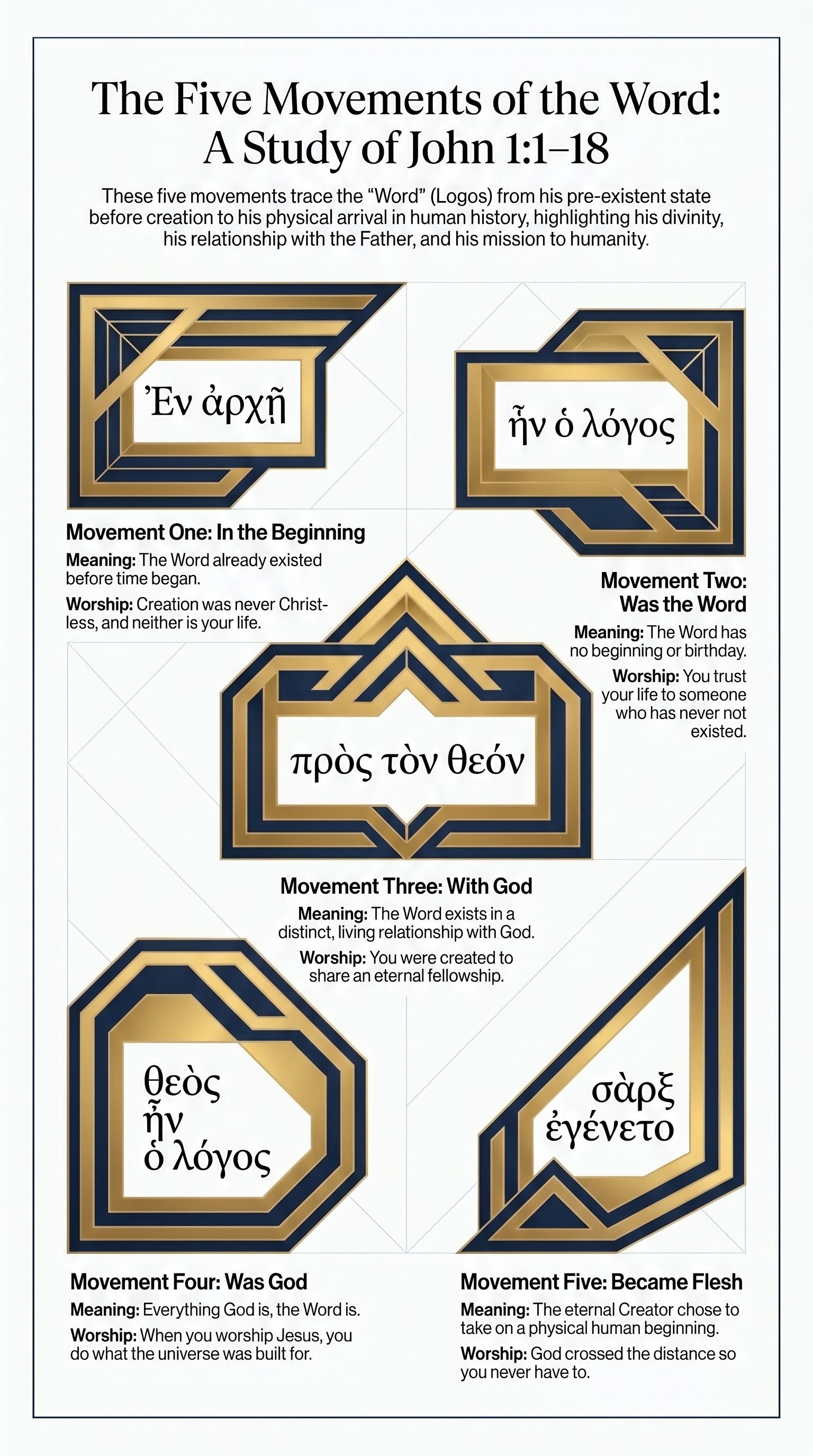
The Five Movements poster. One page, all five movements, the Greek and the worship payoff for each. Print it and tuck it inside your Bible.
Everything above, compressed into a lesson you can teach this week. Sunday school, small group, or family devotions. Forty-five minutes with discussion; thirty without. Take it; it's yours. And here's the quiet gift inside this section: the next time your group hits John 1 and every head turns toward you, you won't just have an answer. You'll have a lesson.
Title: “The Word Moved In” (John 1:1–18). Big idea: Jesus is the eternal Word, with God and truly God, who became flesh so we could know God.
Open (5 min): Ask: “When you hear the Word of God, what do you picture?” (Most will say the Bible. Don't correct them; John is about to enlarge it.) Read John 1:1–18 aloud, slowly.
Point 1 · Before the beginning (1:1a): John reopens Genesis on purpose. Same first words, same speaking God, same light in the darkness. The Word already was when the beginning began. Everything else “became”; he never did (1:3).
Point 2 · With God (1:1b, 1:2): distinct enough for relationship. Fellowship and love inside God's own life before creation (John 17:24). God made us from fullness, not loneliness.
Point 3 · Was God (1:1c): everything God is, the Word is. Confirmed by the whole Gospel: Creator (1:3), life-giver (1:4), worshiped (20:28). One God; Father and Word distinct. If it fits your group, tell them about Nicaea in two sentences: the church once staked everything on this clause, and “begotten, not made” is John's grammar set to a creed.
Point 4 · Became flesh (1:14): the crossed threads. The eternal “was” chose to “become.” He “tabernacled” among us: the glory that filled the tent now walks in sandals, “full of grace and truth.”
Point 5 · So that we could become (1:12): the prologue's trade. The Son of God became human so that humans could become children of God: “to all who received him... he gave the right to become children of God.”
Guardrail to state out loud: “Logos doesn't mean everything Greek philosophy ever meant by it. John defines his own term: with God, was God, became flesh.”
Land it (1:14): God's answer to our distance from him was not a memo but a move. The Word moved in. Close in a prayer of adoration. No application list this week; let them marvel.
Plain-English questions, no trick wording. Pass this and you’re ready to teach the prologue. If one stumps you, it points you to exactly the section to reread.
Five short devotions to close out your masterclass, one a day, Monday through Friday. Each takes about three minutes. Don't read ahead. Let each day's verse have its own day, and end with the one-line prayer said slowly, out loud if you can.
Day 1 · He was already there (John 1:1). Read the verse, then sit with one word: was. Before your week was planned, before your name was chosen, before light existed, the Word was. Today will bring you nothing he hasn't already seen from eternity. You are walking into a day that is old news to the One who loves you. Walk in calmly. Prayer: Lord Jesus, you were there before everything, so be first in everything today. Amen.
Day 2 · The light still shines (John 1:4–5). “The light shines in the darkness, and the darkness has not overcome it.” John doesn't say the darkness is gone. He says it hasn't won. Somewhere in your life there's a patch of dark that has been arguing otherwise: a diagnosis, a prodigal, a habit, a grief. The verse is present tense. The light shines. Still. There. Prayer: Father, shine where it's darkest in me, and let me stop negotiating with shadows. Amen.
Day 3 · The right to become (John 1:12). “To all who did receive him... he gave the right to become children of God.” Not the chance. Not the application form. The right. Your place at God's table isn't a mood he's in; it's a standing he gave. You'll fail somewhere today, and afterward the verse will still read exactly the same way. Prayer: Father, today let me live like a child with a right, not an applicant on trial. Amen.
Day 4 · He pitched his tent (John 1:14). The Word didn't commute from heaven. He moved in: tabernacled, pitched his tent in the neighborhood of sinners. Which means God knows your kind of tired, your kind of hungry, your kind of tempted, from inside. Whatever you carry into this Wednesday, you do not carry it in front of a spectator. You carry it beside a neighbor. Prayer: Lord Jesus, you came near; keep me from living far. Amen.
Day 5 · My Lord and my God (John 20:28). End where John ends, with Thomas's hand at the wounds and his confession in the air: “My Lord and my God.” You've studied the grammar behind that sentence for days now. Today, don't study it. Say it. It was always meant to be said by a person, to a Person, with the pronoun my. Prayer: My Lord and my God. That's the whole prayer. Amen.
Read John 1:14 one more time, out loud, alone: “And the Word became flesh and dwelt among us, and we have seen his glory, glory as of the only Son from the Father, full of grace and truth.”
You've spent this masterclass in the highest air the New Testament breathes: eternity, deity, the life of God before the worlds. And John's point in taking you up there was always to bring you here: the Word became flesh. The One who was, became. The glory that no one could survive seeing pitched a tent in your neighborhood and invited the neighbors in.
Moses asked to see God's glory and was hidden in a rock while it passed by. John says: we have seen his glory. At a wedding in Cana. On a hillside with bread. On a cross outside the wall. Grace and truth, in a face.
So end this study the way John would want: not with a fuller notebook, but with a fuller heart. Put the outline down. Tell him what you have seen.
Lord Jesus, eternal Word: you were in the beginning, you were with God, you were God, and you became flesh for me. I have studied you; now I worship you. Full of grace and truth: be both to me this week. Amen.